
Industry leaders have challenged universities to rethink on how they prepare graduates for a rapidly changing world. This comes amid calls for universities to produce graduates who are not only academically qualified but also adaptable, creative, and entrepreneurial.
They added that employers increasingly seek professionals with communication skills, leadership abilities, critical thinking, teamwork, and the capacity to solve every day problems. These competencies, are best developed through experiential learning rather than classroom instruction alone.
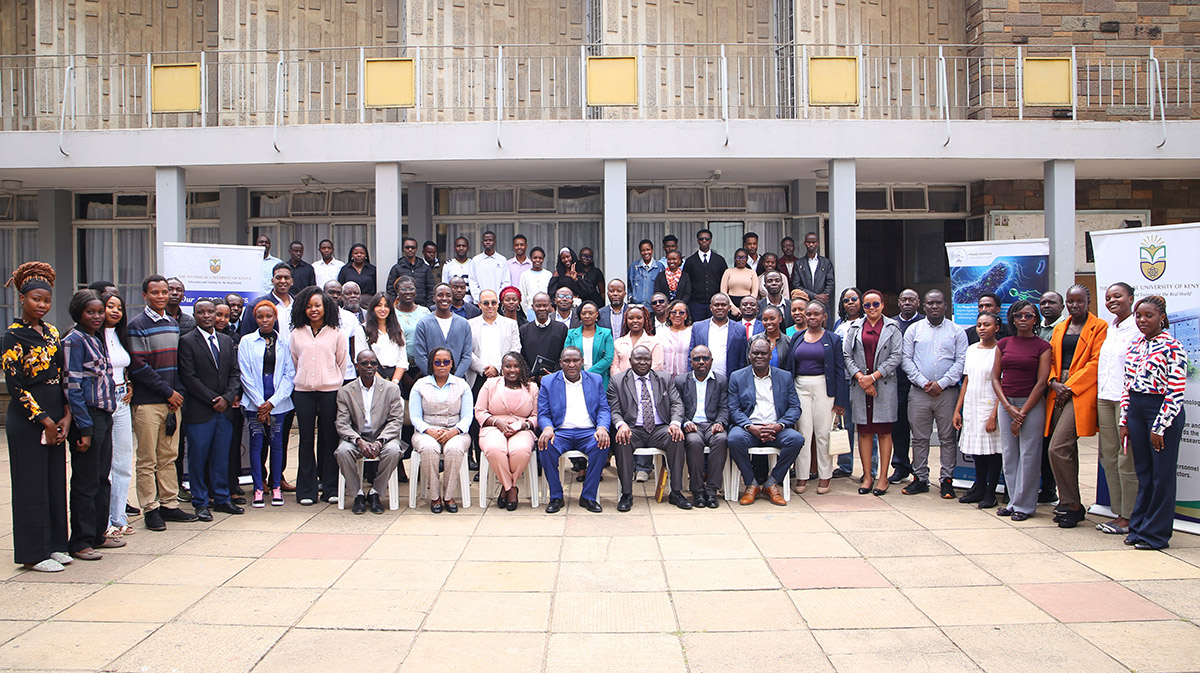
On 31st July 2026, TU-K’s Department of Biological and Life Sciences, under the Faculty of Applied Sciences and Technology, hosted a PHTTRP Undergraduate Research and Innovation Symposium, bringing together students, researchers, lecturers, and industry experts under the theme: “From Theory to Competence: Reimagining STEM Education Through Undergraduate Research and Industry-Based Learning (IBL)."
The Deputy Vice-Chancellor in charge of Academic and student Affairs, Prof. Maurice Amutabi, opened the symposium on behalf of Vice-Chancellor.
He noted that the symposium was more than an academic gathering, since it served as a platform for networking and knowledge exchange. “From this event, students interact directly with experienced researchers, academic leaders, and professionals, gaining valuable mentorship and career guidance,” said he.
He noted that the event was not just a celebration of the achievements of TU-K student, but also the invaluable partnerships that make such achievements possible. Prof. Amutabi was full of praise for IBL saying it helped in reshaping research and Innovation in the country.
“I am glad to note that each speaker is talking about transformation of students from passive learners into active problem-solvers. Industry-Based Learning exposes students to workplace realities, encouraging them to collaborate, think critically, and develop innovative solutions to societal problems.”
The Dean, Faculty of Applied Sciences and Technology Prof. George Amolo, added that students gain confidence while acquiring the practical skills demanded by employers.
He expressed concern over declining student interest in biological sciences and other STEM disciplines. He therefore encouraged institutions to strengthen outreach programmes in secondary schools and communities to inspire the next generation of scientists, innovators, and researchers.
“Early exposure to practical science, helps learners appreciate the relevance of STEM careers in addressing everyday challenges,” said the Dean.
Dr. David Ngigi Ag. Director NACOSTI pointed out that no institution can successfully transform education in isolation. He explained that sustainable innovation depends on partnerships that combine academic knowledge with industrial expertise.
He urged universities to embrace learner-centered approaches that promote teamwork, peer learning, project-based education, and continuous assessment through practical applications rather than traditional classroom instruction alone.
Dr. Samoel A. Khamadi, the Director, Center for Virus Research and Deputy Director KEMRI, noted that TUK PhD-Undergraduate Research and Innovation Symposium demonstrated that when academia and industry work together, education becomes more relevant, innovation flourishes, and the journey from theory to competence becomes a reality.
He urged participants to continue reimagining STEM education by making undergraduate research an integral pathway to innovation, entrepreneurship and national development.
Dr. Patrick Okanya, Chairman, DBLS noted: “The symposium captures our shared vision of transforming higher education from knowledge acquisition to competence development. As universities respond to rapidly evolving societal and industrial needs, it is increasingly important that our graduates leave not only with academic knowledge but also with practical skills, research competence, innovation capacity, critical thinking and problem-solving abilities.”
Dr. James Munyao, a lecturer in the department, gave a brief on the success on IBL, highlighting a powerful message: learning should not end in lecture halls. Instead, universities must create opportunities for students to apply classroom knowledge to real-world challenges through research, innovation, and partnerships with industry
Participants observed that while developed nations dedicate significant resources to research and innovation, many African countries still invest relatively little adding that increasing research funding would strengthen laboratories, improve learning infrastructure, expand postgraduate opportunities, and encourage commercialisation of locally developed technologies.
They emphasised the need to establish innovation hubs, expand industrial placements, support undergraduate research, and create policies that encourage commercialisation of student innovations. Such initiatives would strengthen Kenya's innovation ecosystem while contributing to national development.
The event was sponsored by TU-K and Phage Hunters Training and Research Programme and was attended by representatives from the National Research Fund (NRF), KENIA, ICIPE, ILRI, REMED, KEPHIS, KEPHIS and SCOKA.