
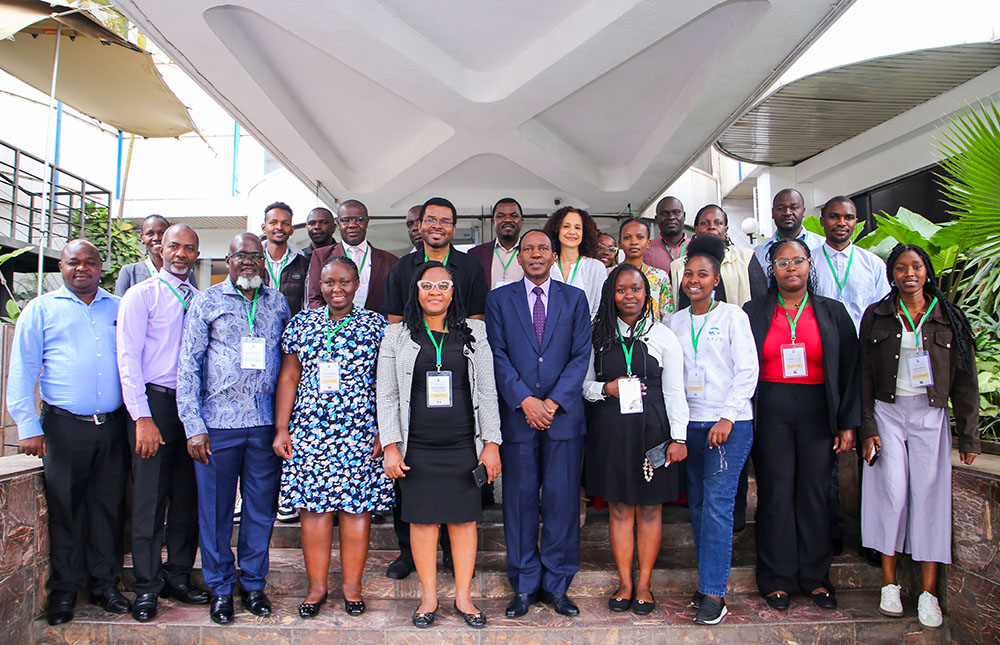
Today marked the beginning of a 4-day hybrid capacity building workshop on Space-Weather Physics at Nairobi Safari Club.
The workshop themed, ‘Effects of the Space Environment on Critical Infrastructure over Sub-Saharan Africa’ is convened by the Technical University of Kenya in collaboration with partners from the University of Bath, United Kingdom.
In his opening remarks, read by Prof. Paul Wambua, the Vice-Chancellor underscored the importance of the workshop in building capacities of the next generation of Space-Weather Physics researchers to solve everyday challenges.
“Today, we gather not only to share knowledge but to build capacity, strengthen collaboration, and chart a path toward safeguarding critical infrastructure across Sub-Saharan Africa.”
“Space weather science is not abstract. It has direct implications on satellite operations, power grid protection, aviation safety, telecommunications, and even resource exploration. By building expertise in this area, we are equipping Africa to anticipate, mitigate, and respond to challenges that affect our economies, our security, and our daily lives.”
Through partnership between TU-K and The University of Bath, the two institutions launched a project in April 2026 that will run through to September 2027. The project is supported by the Africa-UK Physics Partnership Collaborative Projects, through funding from UK Science and Technology Facilities Council (STFC). As part of the project there will be two workshops and this is the first one
Under this collaboration, the Prof. Mutua highlighted noteworthy infrastructural investments to support research activities in this field.
“This partnership goes far beyond this workshop. The collaboration will see the installation of ten research-class Global Navigation Satellite Systems receivers across East Africa, and the establishment of a dedicated Space Weather Laboratory at TU-K. This laboratory is the first of its kind in our country, laying the foundation for world-class research and training in space science in the University.”
The Vice-Chancellor also reaffirmed the University’s full commitment and goodwill in supporting the initiative to ensure the benefits of the collaboration are maximised for all partners. He urged participants to approach the workshop with curiosity, openness, and determination.
In her remarks, Prof. Cathryn Mitchell, the Project Lead from the University of Bath, stated that the project aims to strengthen space-weather research and equip the next generation of scientists with specialised expertise in the field and the ability to apply their knowledge to real-world satellite-based services.
“The aim of this project is do three things; develop scientific expertise, enhance research capacity and instrumentation across Sub-Saharan Africa, and translate physics-based computer modelling into practical space-weather services.”
Key collaborators from the Kenya Space Agency also bring a lot of additional instrumentation and scientific expertise to the project. Other collaborators from different groups will contribute in research and teaching in the field sites, and the equipment will complement the arms of observations and the connection to the space weather services.
Prof. Mitchell also emphasised on inclusivity, encouraging participants to actively contribute to discussions in the workshop and network.
Prof. Paul Baki, the Project Lead at TU-K said the workshop seeks to equip researchers and students with skills to understand and address the impact of space weather on critical technologies, including satellites, aviation, GPS, power grids and oil pipelines.
“Space weather is conditions in the near-Earth space environment created by the Sun and which affect technologies both on Earth and in space. The workshop brings together lecturers and students from about 16 countries, with the aim of strengthening research collaboration across the continent,” he said.