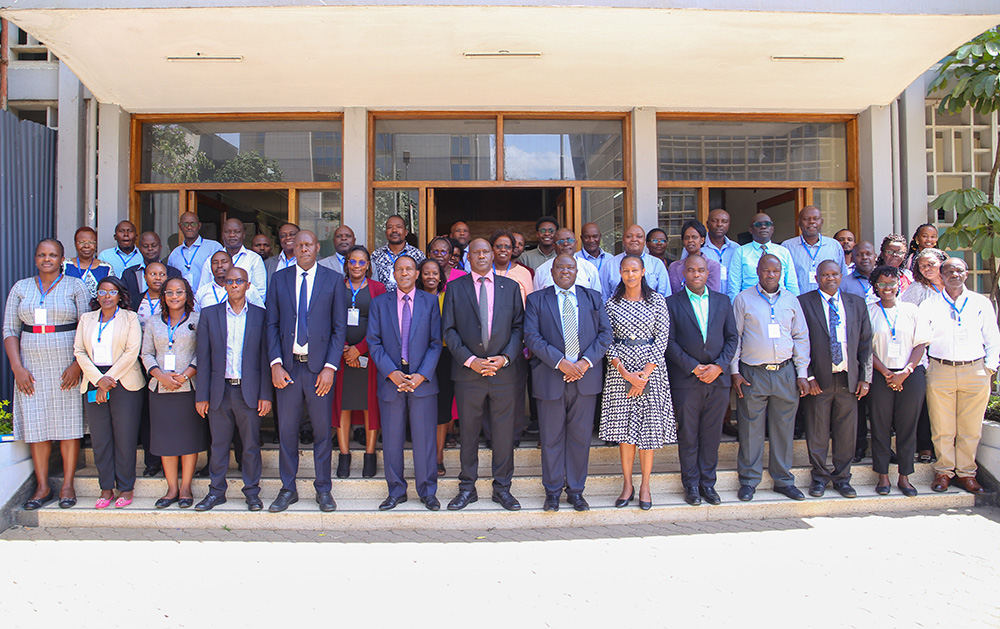
The Technical University of Kenya TVET is currently conducting a five-day Competency-Based Education and Training (CBET) and Recognition of Prior Learning (RPL) practitioners’ training, facilitated by the TVET Curriculum Development, Assessment and Certification Council (CDACC). The training aims to strengthen institutional capacity for the effective implementation of CBET and RPL training and assessment processes.
In addition, the training seeks to empower participants to serve as CBET and RPL champions by providing leadership and advocacy in the adoption and institutionalisation of these approaches within the University.
Speaking during the opening ceremony held on 9th February, 2026, the Chief Executive Officer of CDACC, Prof. Kisilu M. Kitainge, emphasised the critical role of CBET and RPL in transforming skills development and expanding access to formal qualifications. He noted that the two approaches are central to aligning education and training with labour market needs while recognising competencies acquired outside formal education systems.
“CBET and RPL are not optional reforms. They are necessary pathways for ensuring that skills, knowledge, and experience, regardless of where they are acquired, are recognised, assessed, and certified,” said Prof. Kitainge.
He reiterated CDACC’s mandate to support institutions in implementing CBET and RPL with quality and integrity.
“Our role as CDACC is to support institutions to implement these systems with integrity, quality, and consistency,” he added.
Prof. Kitainge further underscored the need for institutions to move beyond policy discussions to practical implementation, highlighting Recognition of Prior Learning (RPL) as a structured pathway through which skilled individuals without formal certification can access education and employment in an appropriate and meaningful way.
“Not every capable individual follows the conventional academic pathway of attaining a C+ and above. It could be the person who drove you here today, or the person who cleaned this room.”
He emphasised that universities have a responsibility to prepare a future workforce capable of serving the country. As such, training institutions must be confident that when responsibilities are handed over to future generations, the nation will be in safe and capable hands.
On behalf of the Vice-Chancellor, Prof. Benedict Mutua, Prof. Paul Wambua, Deputy Vice-Chancellor, Institutional Advancement and Enterprise (IAE), welcomed the CDACC team and industry partners to the University. He commended the large turnout, noting that it demonstrated the University’s commitment to the training. He challenged participants to rethink curriculum delivery, assessment, and certification to ensure learning outcomes genuinely reflect competence, and urged them to take the training seriously, as they would play a key role in cascading the knowledge gained to other staff members.
The Deputy Vice-Chancellor, Academic and Student Affairs, Prof. Maurice Amutabi, reaffirmed the University’s commitment to skills-based education aligned with national development priorities. He encouraged participants to treat the training as a strategic investment in their professional growth and institutional development.
Prof. Amutabi also emphasized the role of academia in shaping the CBC discourse, calling on scholars to improve the quality of publications supporting the competency-based system.
“CBC is here, yet textbooks are limited. Very soon, universities will begin receiving CBC students. How ready are we for the 2029 entry? So far, I have only seen two textbooks aligned to this system,” he observed.
The Deputy Vice-Chancellor, Research and Technology Development, Prof. Alfred Orina, highlighted the broader implications of CBET and RPL for innovation, research, knowledge transfer, and community engagement, emphasizing the responsibility of universities to bridge the gap between academic knowledge and practical skills.
In addition to the remarks made by the Deputy Vice-Chancellors, the Director of TUK TVET, Dr. Mercy W. Mwaniki, expressed appreciation to the University management for their support, noting that it had enabled significant progress and achievements. She announced that the Directorate of TVET Strategy and Development has now rebranded to TUK TVET.
She added that CBET and RPL demand institutional readiness, collaboration among academic staff, and continuous capacity building to ensure successful implementation.
 Academic Calendar for Diploma and Undergraduate Students June – September Semester, 2026