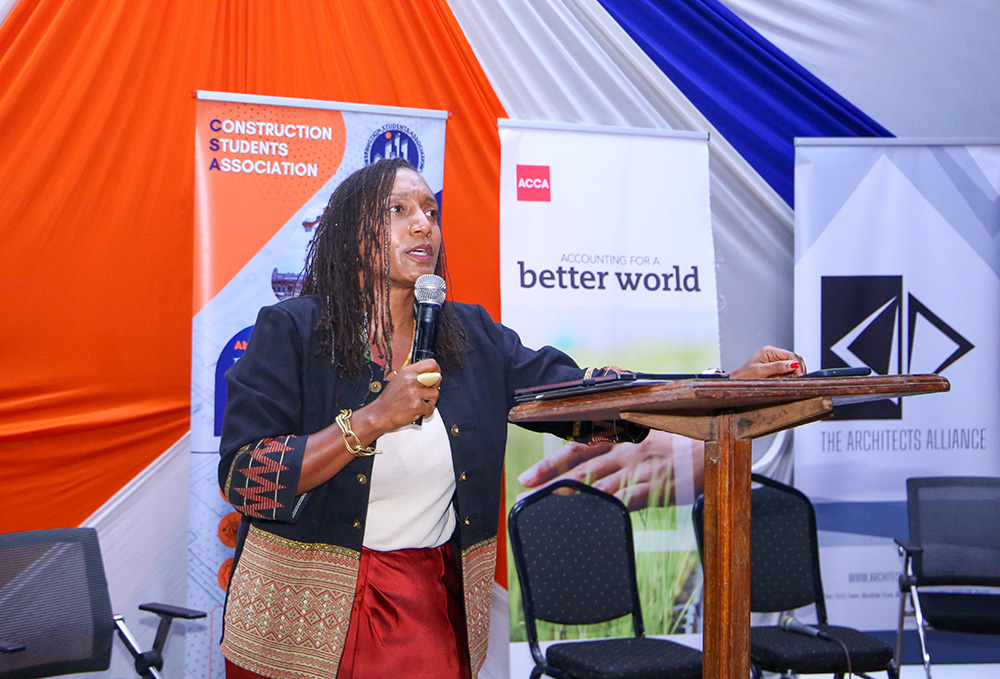
The Faculty of Engineering and the Built Environment (FEBE) held a compelling public lecture themed “Choosing Leadership in a City of Theatrics.” The public lecture was delivered by Robyn T. Emerson who is the Executive Director of Yellow Rose Kenya and Founding President (Former) of Women in Real Estate.
In her address, she challenged students and built environment professionals to critically reflect on their responsibility in shaping cities through principled, transparent, and accountable leadership.
She was received by Prof. Cleophas Maende, the Dean of the Faculty of Engineering and the Built Environment, alongside Dr. Joseph Kedogo, the Chairperson of the Department of Architecture, Design and Planning. The lecture was hosted by the Architecture Students Association in partnership with the Association of Engineering, Construction and Architecture Students (AECA), the Construction Students Association (CSA), the Association of Engineering Students (AES), and the Students Association of The Technical University (SATUK), demonstrating strong collaboration between faculty leadership and student bodies.
The lecture drew students from various departments within FEBE, including architecture, planning, quantity surveying, engineering, and construction management, as well as chairpersons of departments and faculty members.
Ms. Emerson framed the modern cities particularly Nairobi, as areas defined by “procedural theatre,” where processes such as public participation are sometimes performed symbolically rather than substantively. She argued that while the crises can be managed using “old, inherited scripts,” true leadership requires the courage and imagination to write a new story for the future.
“One can manage a crisis using old, inherited scripts,” she noted, “but leadership requires the imagination to write a new story for the future.” She quoted Taaka Awori while urging students to move beyond technical efficiency and instead lead for justice, integrity, and constitutional accountability.
Drawing from documented urban development cases, Emerson highlighted recurring concerns in public participation processes, including the lack of accessibility, inadequate information sharing, predetermined decisions, and failure to incorporate community feedback. She introduced what she described as a “nine-pillar test” for meaningful public participation that is anchored on accessibility, information, time, resources, diversity, influence, purpose, consideration, and feedback, encouraging students to treat it as a structural integrity test for democracy in development projects.
The session placed particular emphasis on the constitutional and statutory foundations of public participation, referencing Articles 10, 35, and 118 of the Constitution, as well as relevant provisions in planning law. Emerson underscored that public participation is not a favour granted by developers, but a constitutional obligation and a professional responsibility for those working in the built environment.
In a powerful call to action, she challenged students to reconsider their professional identities. “You are not just designing for a client,” she said. “You are designing within a democracy.” She warned that projects built on flawed or fraudulent processes risk becoming legal liabilities, regardless of the permits or approvals obtained.”
The lecture was interactive, with students invited to reflect on their future roles as architects, planners, engineers, and surveyors. Emerson encouraged them to transition from being “transactional enablers” to becoming guardians of ethical development, professionals who safeguard both the technical and moral foundations of the city.
The outgoing student leader who helped organise the event expressed gratitude to the faculty, partners, and university administration for their support, noting that the lecture was the result of collaborative planning and a shared commitment to meaningful dialogue. Special recognition was given to student association leaders and professional partners who contributed to the success of the event.
The public lecture forms part of FEBE’s broader commitment to exposing students to current talks shaping the built environment sector. By hosting conversations that bridge technical training with governance, ethics, and civic responsibility, the faculty continues to prepare graduates not only as competent professionals, but also as transformative leaders.
 Academic Calendar for Diploma and Undergraduate Students June – September Semester, 2026