The Institute of Electrical and Electronics Engineers (IEEE) Student Branch at the Technical University of Kenya, today held the EV Horizons Conference 2026. The conference saw industry leaders and academia rallying students to take a leading role in shaping Kenya’s electric mobility future.
Delivering the keynote address, Dennis Muchoki, CEO and Co-founder of E-Moti, and Former SATUK Chairperson, said that E-Moti is purely an electric transportation service leveraging mass transit to provide more efficient and sustainable mobility for companies and communities.
In his address he underscored the role of innovations in addressing urban transport challenges while contributing to climate action. With this, he challenged students and innovators to position themselves at the forefront of the e-mobility transition by recognising critical turning points in technology and business.
“If it wasn’t for people believing in what seemed impossible, many of today’s innovations would not exist,” he said. “When you identify an inflection point and combine it with possibility and perseverance, that is where real change happens.”
Equally compelling were insights derived from Dr. Mary Ahuna, Patron of IEEE across universities in Kenya, and the Chairperson, Department of Electrical and Electronics Engineering. She positioned e-mobility as a practical and urgent solution to current challenges.
“E-mobility is no longer a distant vision, it is a practical pathway towards sustainable transport systems,” she said.
Dr. Ahuna pointed to visible progress on Kenyan roads, noting the emergence of locally manufactured electric buses.
“When we see electric buses made in Kenya, it reminds us that the solutions to our challenges lie within us, that is through our students, our research, and our innovation,” she stated.
She further emphasised the broader impact of the transition, arguing that it presents a transformative opportunity to reduce emissions, improve energy efficiency, and enhance the quality of life in our cities and communities.
Prof. Maurice Amutabi, Deputy Vice-Chancellor for Academic and Student Affairs, challenged students to rethink how they approach innovation. “We may have solutions around us, but we sometimes fail to see their value until others do.” he observed. He underscored the need to harness indigenous knowledge and local context in solving modern challenges.
On the other hand, Prof. Isaac Orina, Deputy Vice-Chancellor for Research and Technology Development, stressed the importance of specialization in an increasingly competitive job market.
He noted that after university, the industry demands expertise, and specialisation is what enables young professionals to thrive adding that some of TU-K’s former students have successfully carved niches in areas such as solar energy and emerging technologies.
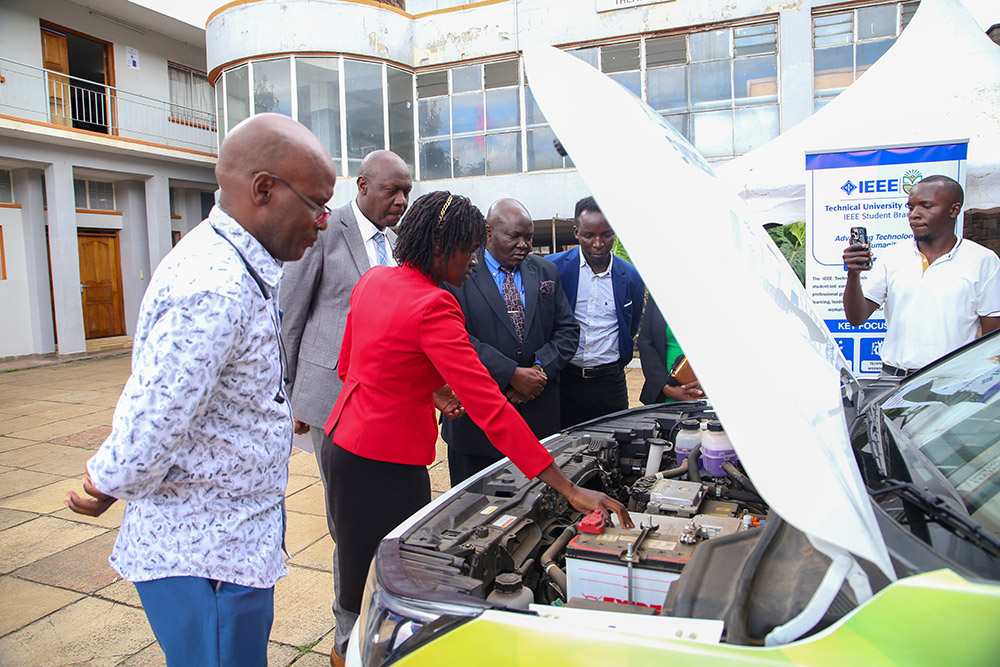
The event also featured exhibitions of locally developed electric vehicles, including Kenya Power & Lighting Company PLC, reflecting the country’s growing capacity in clean mobility technologies.
 COLLECTION OF CERTIFICATES (March 2026 Graduates)