
To remain relevant and impactful, scholars in the arts and humanities should continuously generate and disseminate new knowledge that addresses contemporary societal challenges.
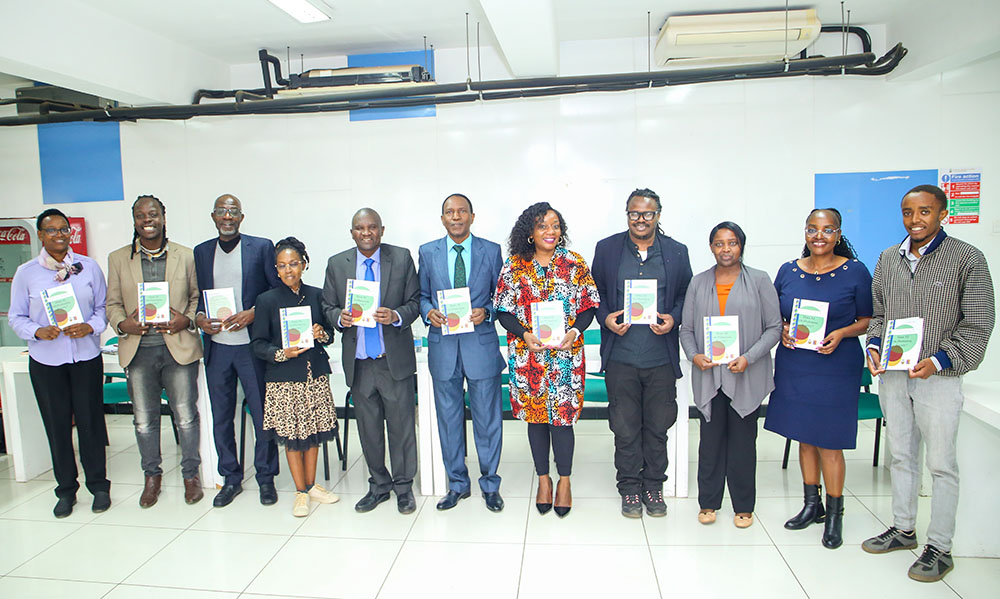
The Deputy Vice-Chancellor, Institutional Advancement and Enterprise, Prof. Paul Wambua, made these remarks at the launch of the second issue of the Writing, the Arts & Humanities in Africa (WAHIA) Journal at the TU-K’s Samsung Lab. This year's issue is titled, “Does AI (de)Humanize Society?”
Prof. Wambua emphasised that knowledge production in the humanities should not be viewed as secondary, but as a critical component in building societies that are equitable, inclusive and responsive to human needs.
“At a time when our continent is growing with rapid technological change, economic transformation, and social reimagination, the humanities remind us of the enduring importance of culture, identity, and human values.”
He noted that the journal provides an important platform for African scholars to interrogate the continent's histories, narrate its present realities and imagine its future. Thus, he encouraged students, PhD candidates, young researchers and established scholars to take advantage of academic platforms such as the WAHIA Journal to share their research, ideas and perspectives with wider audiences.
“The publication of this journal is more than an academic milestone. It is a bold statement about the vitality of the arts and humanities in Africa. As we launch this second issue, let us commit ourselves to sustain the momentum.”
Prof. Peter Matu, Executive Dean, Faculty of Social Sciences and Technology, reinforced the Deputy Vice-Chancellor’s remarks by challenging researchers to make the journal sustainable.
Dr. Lydia Muthuma, a Senior Lecturer in the Department of Creative Arts and Media (DCAM), in her remarks emphasised that universities must complement their traditional focus of teaching, examinations and administrative activities with the knowledge creation and publication.
“Universities are universities because they are communities of scholars that come together, one, to teach and, more importantly, to create knowledge.”
She stressed that research, knowledge creation and publication are integral to the work of a university, adding that the WAHIA Journal provides an important vehicle for scholars to share ideas and contribute to academic discourse.
Dr. Esther King’ori from Strathmore University announced plans to publish a special issue of the WAHIA Journal as part of celebrations marking 10 years of the Bachelor of Arts degree. She said the initiative will follow a symposium scheduled for 10th November, 2026, where participants will submit abstracts for consideration and presentation during panel discussions.
“We shall select the best proposals and invite the writers to come and submit articles for a special issue of WAHIA Journal,” said Dr. King’ori.
She encouraged members of the academic community to identify and share the journal opportunity with potential contributors, noting that scholars encountered in different academic and professional spaces could have valuable ideas to contribute to the special issue. The initiative will provide scholars with an opportunity to develop their symposium presentations into publishable articles and contribute to academic discourse in the arts and humanities in Africa.
The launch was attended by senior members of faculty from Moi University, The Technical university of Kenya and Strathmore University.
The Writing the Arts & Humanities in Africa (WAHIA) Journal was established through a collaboration between the Technical University of Kenya (TU-K) and Strathmore University. The collaboration emerged following challenges encountered in publishing work produced through a project between TU-K and Columbia University. The inaugural issue of the journal was journal titled “The Dagoretti Experience” that was published on 1st December 2024.