The Technical University of Kenya (TUK) has taken a significant step in strengthening local scientific capacity to address antimicrobial resistance (AMR) by hosting its first independent hands-on training on bacteriophage research through the Department of Biological and Life Sciences. The workshop brought together researchers, students, and professionals from multiple institutions, all working to find innovative solutions to drug-resistant bacterial infections.
The four-day workshop held from 7th to 10th April 2026 is part of an ongoing collaboration between TU-K and the Phage Hunters Training and Research Program (PHDRP), formalised through a Memorandum of Understanding that was signed in July 2025. The partnership is focused on building capacity in bacteriophage science through structured training, research, and collaborative innovation.
According to Dr. James Munyao, the training coordinator, bacteriophages present a versatile and promising solution in the wake of antibiotic resistance. He explains that bacteriophages are viruses that attack, infect, and kill bacteria. In clinical settings, they offer a powerful complementary approach to conventional treatments, particularly in addressing antimicrobial resistance.
“The reason why bacteria is becoming resistant is because there are mutations that are happening in bacteria that are making the antibiotics and the medications not work,” said Dr. Munyao.
“Bacteriophages are becoming a popular treatment method because, unlike antibiotics, they are living organisms, and so, as the disease-causing bacteria changes, it changes with it. That is why the world is now moving towards using it together with antibiotics. Remember, we are not doing away with antibiotics but combining both to improve treatment outcomes,” he added.
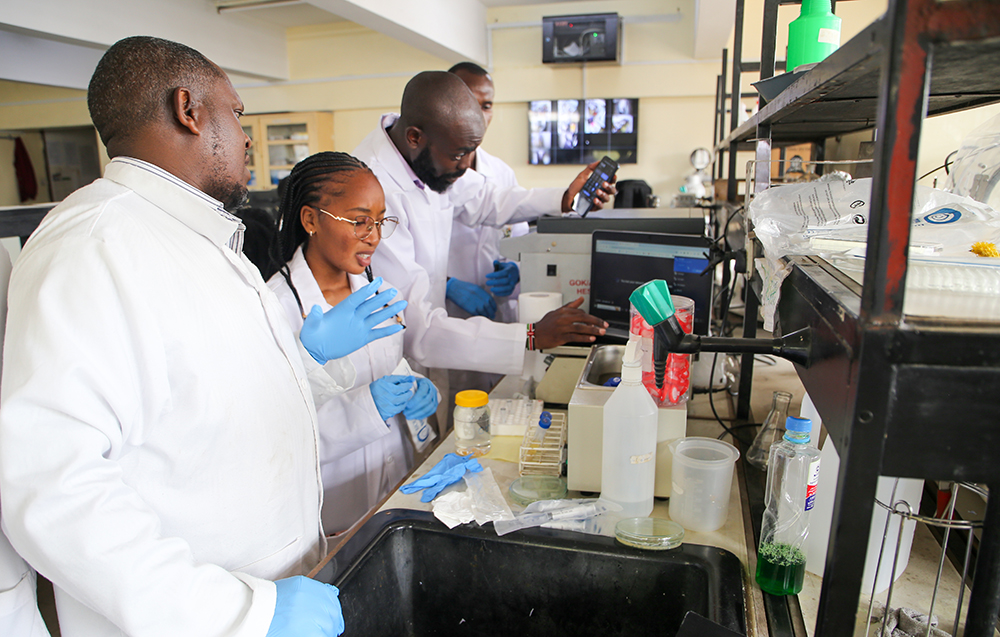
The programme was designed as a blend of theory and practical application. Participants completed several weeks of online training before convening at TU-K for a week of hands-on lab work.
This was the first time TU-K conducted a complete bacteriophage training programme in its own facilities. Previously, theoretical sessions were held in the university, while practical sessions were partially conducted in external laboratories. This new development confirms the institution’s growing capacity to independently host such advanced scientific training.
A highlight of the training was the fieldwork and laboratory sessions, where participants actively engaged in the full research cycle. This began with sample collection from natural environments such as rivers, wastewater and sewage systems - areas known to harbour diverse bacterial populations and by extension, bacteriophages. The samples were subsequently transported to TU-K laboratories for processing and analysis.
“We brought these samples to the lab, isolated bacteriophages, and tested them to see whether we had successfully isolated them,” said Dr. Munyao.
Participants then conducted experiments to expose bacteriophages to bacterial cultures in controlled laboratory conditions. This step allowed them to observe first-hand how bacteriophages infect and destroy bacteria, providing compelling evidence of their potential as a complementary solution to antibiotics, particularly in the face of increasing drug resistance.
“We actually proved that we can now successfully take a cohort of people from theory to sample collection, to testing, and actually confirming that our bacteriophages are working against bacteria,” Dr. Munyao emphasised.
The implications of these findings extend far beyond the laboratory. According to Dr. Munyao, bacteriophages have wide-ranging applications across human health, veterinary medicine, agriculture, and environmental management. This approach not only enhances treatment outcomes but also reduces reliance on antibiotics. He further emphasises that it aligns with the One Health Approach, which recognises the interconnectedness of human, animal, and environmental health in addressing complex disease challenges.
Beyond the immediate technical skills gained, the training forms part of a larger vision to position TU-K as a regional hub for bacteriophage research and innovation. A key priority is the establishment of a phage biorepository, a structured “phage bank”, that will support ongoing research, training, and future therapeutic applications.
The university aims to expand such programmes, integrate bacteriophage science into its academic curriculum, and strengthen research output through continued collaboration with local and international partners.
Dr. Munyao also noted that the university is exploring the introduction of Course-Based Undergraduate Research Experiences (CUREs), an innovative model that integrates research into undergraduate education. Through this approach, students will actively participate in real-world scientific investigations early in their academic journey and contribute to ongoing discoveries while developing critical practical skills. This initiative is expected to significantly advance scientific output while strengthening Kenya’s capacity to respond to antimicrobial resistance.
Ultimately, the university’s long-term vision is to translate research into real-world impact by influencing policy and advancing the adoption of phage therapy across Kenya and the broader African region.
“The endgame is to carry out more research, inform policy, and have phage therapy as a mode of treatment in Kenya and Africa,” concluded Dr. Munyao.
 Academic Calendar for Diploma and Undergraduate Students June – September Semester, 2026